
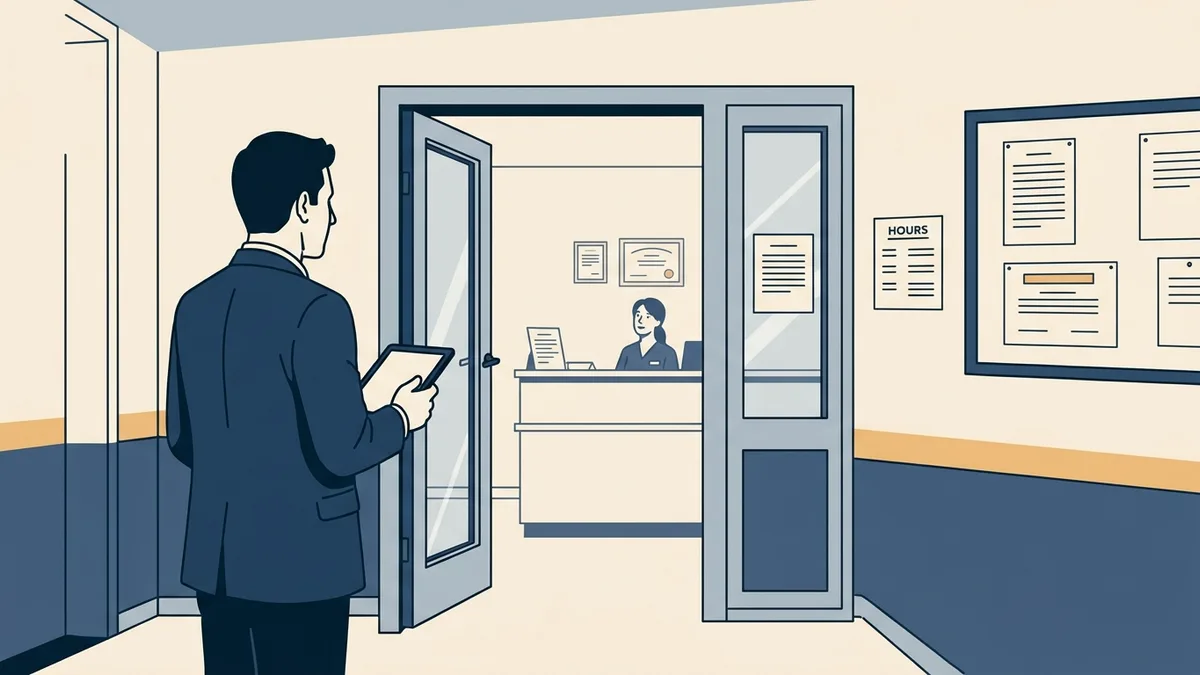
An IDTF is a moderate-risk supplier, so Medicare conducts an on-site visit as part of screening under 42 CFR 424.518, and standard 14 permits unannounced inspections afterward. The visitor checks the facts you certified: the site, equipment, insurance, staff credentials, complaint log, posted standards, phone and hours.
Under 42 CFR 424.518, a provider type labeled moderate risk gets an on-site visit as part of screening. IDTFs are in that group. Standard 14 of 42 CFR 410.33(g) goes further: CMS may conduct unannounced inspections afterward, and the facility's hours must be posted. The visitor is not looking for anything exotic. They are checking the facts you certified.
How does a visit begin?
The first test is whether the place is what the application says. A visitor will look for the address on the enrollment, an operating business with a staff member present, the posted hours and the signage. Enrolling before the space is finished is the error that shows up first. If the scanners are still crated, the phone is not connected or the front door is locked during posted hours, the answers on the application are already in doubt.
A bare-bones fixed site is not enough. Standard 3 requires a real physical site with handwashing, patient privacy and records stored on site. A PO box, a mailbox or a hotel room does not qualify.
Which items does the visitor ask to see?
Based on the standards themselves, expect requests such as:
- Equipment. The equipment on the application is physically there. For portable equipment, a catalog with serial numbers. See equipment and calibration.
- Calibration records. Evidence that equipment is calibrated per the manufacturer.
- Insurance. The liability certificate for the location. See the insurance rule.
- Staff credentials. State license or certification for technical staff on duty. See technologist credentials.
- The complaint log and the posted standards. See the log and the posting.
- A listed business phone. The number in the local directory.
- Patient records. Standard 13 requires retrieval within two business days.
Who should be there?
Someone who can speak for the center and open the binder. The owner or manager is ideal, and every shift should know who to call. Staff should be able to say who the supervising physician is and how that person can be reached, since unreachable supervision is something an inspector can note. Staff do not need to rehearse answers. They need to know where the documents live.
Where do centers fail after the visit?
A facility that fails a standard at enrollment can be denied under 410.33(h). One that fails later can face revocation. Common sources are insurance that expired, an equipment change not reported within 90 days, a physician who departed without a 30-day report, and sharing space with another enrolled supplier. The last is the one a visitor can see with their own eyes. Read the shared space rule before you sign a lease.
How should staff handle the conversation?
Politely and accurately. A visitor will ask who works there, what the equipment is and where records are kept. Staff who guess make mistakes; staff who say "I will get the person who keeps that binder" do not. Brief your team on three rules: identify the visitor, call the manager at once and answer only what you know. Do not leave a visitor alone in a clinical area, and do not refuse access. Standard 14 allows the inspection, and a center that obstructs one invites a bigger problem than anything it was trying to hide.
Treat the visitor's request for documents the way you would a patient record request: one named person fetches and logs what is handed over. Keep a note of who came, when, and what they asked to see.
How do you rehearse without making a show of it?
Run a quarterly mock visit. The owner or a consultant walks in as the visitor, with the 17 standards as the script. The point is not to catch staff out. It is to find the expired insurance certificate, the missing serial number or the unposted notice while there is time to fix it. Write down each finding, the fix and the date. After two or three rounds, the results are boring, which is the goal.
What does the visit not decide?
It does not replace accreditation. For MRI, CT, nuclear medicine and PET, a separate accreditation review applies, run by a designated organization with its own process. See the accreditation requirement. Nor does the visit cover state requirements such as radiation registration or facility licensing, which vary by state and are handled separately.
Is there a checklist you can print?
- The address on the enrollment matches the sign on the door.
- Hours are posted and the door is open during them.
- The standards are posted where patients can see them.
- The business phone rings at the location and is listed locally.
- Equipment in the rooms matches the equipment on file, and portable items are cataloged by serial number.
- Insurance certificate is current for this location.
- Credentials are on file for every technologist on shift.
- The complaint log exists and is kept.
- Records for any patient can be retrieved within two business days.
- No other Medicare-enrolled business shares the space.
What happens after the visitor leaves?
The visit becomes part of the enrollment file. For a new enrollment, the contractor weighs it with the application when deciding whether to approve. For an existing center, an inspection that finds a failed standard can lead to a request for correction or to a more serious action, depending on what was found. Whatever the outcome, write a short internal summary the same day: who visited, what they asked and what they saw. If something was missing, fix it at once and record the date. If the contractor asks for a response, make it accurate and keep a copy.
A center that did the walk-through before the visit will have little to correct. A center that did not will discover what the standards meant by reading the findings.
How do you prepare?
- Walk the site as if you were the visitor, with the 17 standards in hand.
- Put one binder at the front desk: insurance, credentials, calibration records, the complaint log and the posted standards.
- Confirm the phone listing, the posted hours and the signage.
- Make sure the supervision coverage schedule matches the hours on the door.
- Name a backup contact for each shift.
A $149 Facility Readiness Review does the walk-through against the standards and lists what to fix, and it is credited toward the enrollment package. Medicare decides the outcome of any visit, and we do not guarantee approval or inspect on anyone's behalf.
Common questions
- Will Medicare visit my imaging center before approval?
- Yes. IDTFs are moderate-risk suppliers, so an on-site visit is part of enrollment screening under 42 CFR 424.518.
- Can inspectors arrive without notice?
- Yes. Standard 14 of 42 CFR 410.33(g) allows unannounced CMS site inspections, and the center must post its hours.
- What documents should be at the front desk?
- Insurance certificate, staff credentials, calibration records, the complaint log and the posted standards, plus how to reach the supervising physician.
Need Help with Licensing or Enrollment?
We prepare the application for your radiologist, owner or authorized official to sign, then track renewals, inspections and changes.