
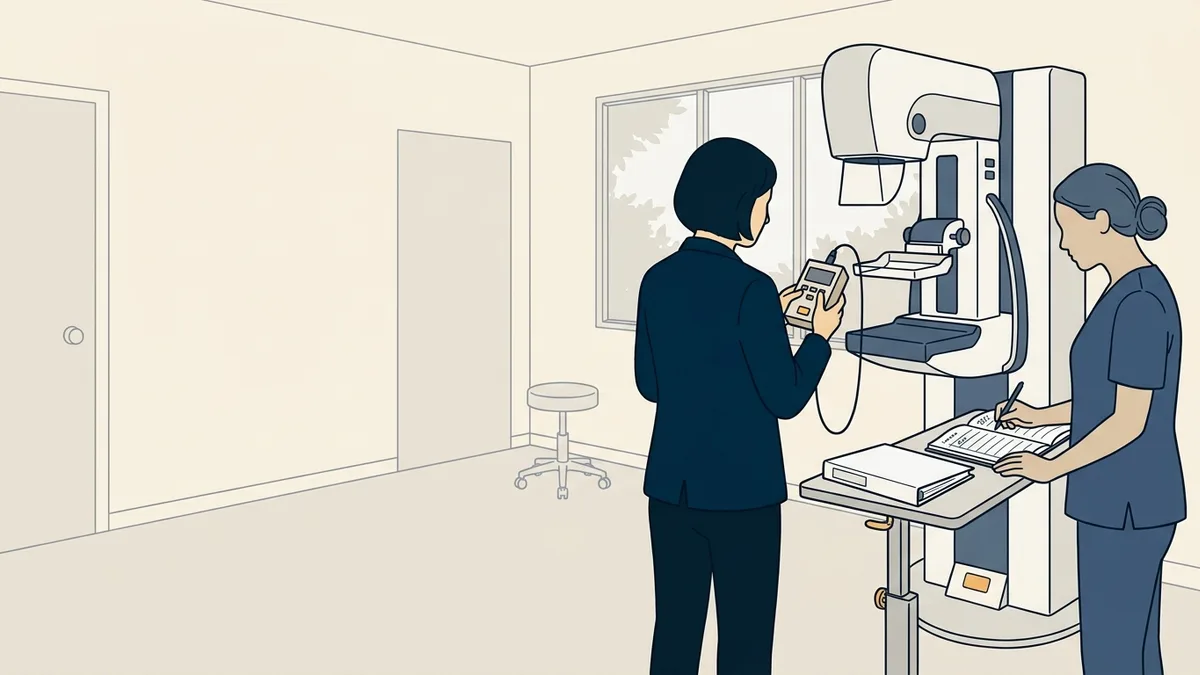
Under 21 CFR 900.12 a mammography facility needs a medical physicist to survey equipment and a quality control technologist for the remaining quality tasks. The physicist needs a license or approved certification, a physical science master's degree, 20 hours of survey training and experience on at least 10 units. Technologists need 40 hours of mammography training and 25 supervised exams.
An MQSA quality control program is the work of several people, and the standards assign it. Under 21 CFR 900.12, the lead interpreting physician, the medical physicist and the quality control technologist each have named responsibilities, and anything not assigned to the first two falls to the third.
Which duties belong to the medical physicist?
Each facility must have a medical physicist's services available to survey mammography equipment and oversee its equipment-related quality assurance. At a minimum the physicist performs the surveys and equipment evaluations and gives the facility the reports.
The qualifications: a state license or approval, or certification in an appropriate specialty by an FDA-determined body; a master's degree or higher in a physical science with at least 20 semester hours of physics; 20 contact hours of specialized training in conducting mammography facility surveys; and experience surveying at least one facility and a total of at least 10 mammography units.
Who is the quality control technologist?
All individual tasks in the quality assurance program that are not given to the lead interpreting physician or the physicist go to a quality control technologist, who may delegate to other qualified personnel while keeping responsibility. This is the person who keeps the daily and weekly logs and notices when a unit drifts.
Radiologic technologists performing mammography need a state license or national certification, 40 contact hours of mammography training, 25 supervised exams and 8 hours of training per modality, then 15 hours of continuing education every 36 months.
Where do files go wrong?
- A physicist's training certificate is on file but the survey count is not.
- A technologist moves to another site and the quality control assignment is not reassigned in writing.
- The physicist's report is signed but the corrective action it requested never appears in the log.
Alternative qualifications and older credentials
21 CFR 900.12 includes alternative initial qualifications for people who qualified under the FDA's interim regulations and kept that qualification active. A physicist who qualified before April 28, 1999 may fall under those provisions, with a different degree and survey history than the current standard. If a long-time physicist is on your roster, ask which paragraph the file relies on and keep the documents that prove it. Do not assume the current requirements describe every person already working.
Matching duties to people
A written assignment sheet avoids arguments on inspection day. List each task in the quality assurance program, the person responsible, the backup and how often it is done. The sheet should state who the lead interpreting physician is, who the physicist is and who the quality control technologist is. When a person leaves, the sheet is the first document to update.
Continuing education and training
Technologists need 15 continuing education hours every 36 months. A facility with several technologists should record each person's cycle start date, since three-year windows rarely line up. A shared spreadsheet with the date each person's cycle began, and the date it ends, lets the administrator see who needs hours soon. The same applies to the physicians' continuing education and the 960-exam count described in the interpreting physician post.
When the physicist is outside the facility
Many facilities use a contracted physicist. The contract should name the person, the services (surveys, equipment evaluations, reports), the response time after a failed test and the way the facility receives each report. Ask for a copy of the physicist's credentials each year, since a physicist who changed employers may have changed the file.
How do these roles fit the larger program?
These roles also show up at the annual inspection; see what an MQSA inspection looks at and the interpreting physician requirements. Mammography (MQSA) Certification Readiness ($1,495 per site) organizes each person's file and a dated renewal list (see pricing). We are not a medical physicist and do not perform surveys.
Common questions
- What does an MQSA medical physicist do?
- Surveys mammography equipment, performs equipment evaluations and gives the facility the reports, while overseeing equipment-related quality assurance.
- How many units must a physicist have surveyed?
- At least one facility and a total of at least 10 mammography units, plus 20 contact hours of survey training.
- What training does a mammography technologist need?
- A state license or national certification, 40 contact hours of mammography training, 25 supervised exams, and 15 continuing education hours every 36 months.
Need Help with Licensing or Enrollment?
We prepare the application for your radiologist, owner or authorized official to sign, then track renewals, inspections and changes.