
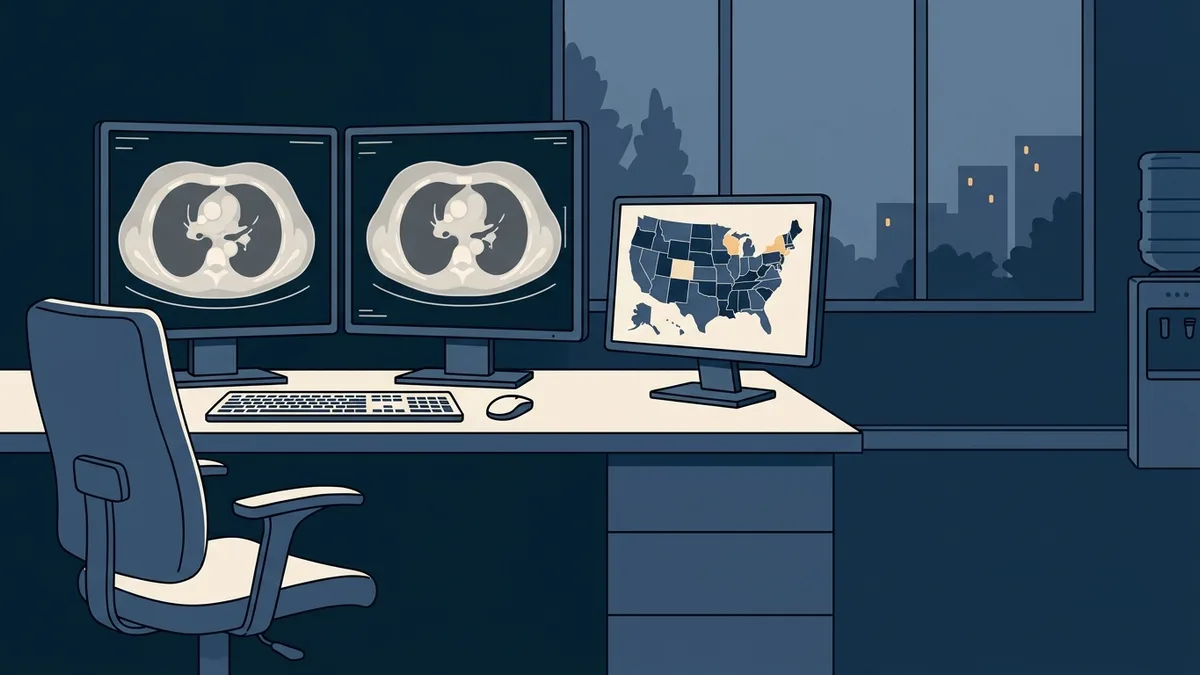
The Interstate Medical Licensure Compact lets a physician apply once through a State of Principal License, receive a Letter of Qualification, and then request separate licenses in other member states. For radiologists it speeds up multistate licensing, but each state still issues its own license and charges its own fee on top of the compact fee.
A teleradiology group that reads for hospitals in many states has one recurring bottleneck: every radiologist needs a license in each state where a patient is located. The Interstate Medical Licensure Compact (IMLC) does not remove that requirement. It shortens the paperwork for getting there.
How does the compact process work?
A physician designates one member state as the State of Principal License (SPL). That state verifies the physician's credentials and issues a Letter of Qualification (LOQ). The physician then picks the states where licenses are wanted, pays the compact fee and each state's fee, and the selected states issue their own licenses.
The compact is not a single national license. Each license issued through it is a regular state license, with that board's renewal rules and discipline authority. The IMLC's own site, imlcc.com, is the only official place to start an application.
Who participates?
As of the IMLC's data through October 31, 2026, 44 states plus Washington, DC and Guam are members, covering 59 licensing boards. The Commission reports 145,733 Letters of Qualification, 69,935 physician members and 246,359 licenses issued through the compact. Those numbers move every month, so treat them as a snapshot.
Not every state is the same kind of participant. Thirty-nine states plus DC and Guam can act as an SPL. Hawaii and Vermont issue licenses through the compact but cannot serve as a physician's principal license state. Alaska, New Mexico and Rhode Island have passed legislation and are still implementing. New York has only introduced it.
Is the compact free of cost to a radiologist?
The IMLC charges a $700 initial compact fee, which is not refundable. Each state then charges its own license fee on top. Renewals are set by each state board. A group planning ten states should budget for ten separate state fees, not one.
Our fee table walkthrough shows how widely state fees range.
Who does the applying, the radiologist or the group?
The physician is the applicant. The compact is built around an individual's credentials, so the radiologist signs the application, answers the eligibility questions and pays the compact and state fees. A group administrator can coordinate the work, gather documents, track which states have been requested and remind the radiologist of next steps. What an administrator cannot do is sign or attest for the physician, and a preparation service cannot either.
The IMLC's site also has an "Add States" function for physicians who already hold a Letter of Qualification, so a radiologist who starts with three states can request more later. We have not verified the compact's exact fee or timing rules for added states, so confirm them on imlcc.com when you plan the second round.
Does the compact have a processing time?
The IMLC pages we reviewed do not give a processing time we can quote, and we do not repeat figures from vendors or search summaries. Each state board has its own queue. For planning, start the application before the hospital's go-live date is set, and treat any promised date from a third party with caution.
How does a group decide whether the compact is worth using?
Compare routes state by state. The compact's $700 fee is paid once, up front, by the radiologist. A traditional application costs only the state fee but means a separate application, separate document requests and a separate wait in each state. A radiologist who needs one state in the near term may find the traditional route cheaper. A radiologist who needs five or more is more likely to come out ahead with the compact, and the gap widens with each additional member state.
The answer also depends on where the radiologist already holds a full license. A compact application starts from that license in the State of Principal License. Without one, there is nothing for the compact to verify.
Whichever route is chosen, record it in the roster. The next administrator should be able to see at a glance which licenses came through the compact and which did not.
Where does the compact stop helping?
Three places come up for radiology groups:
- Non-member states. A hospital in a state outside the compact still needs a traditional application.
- Hospital privileges. A license lets a radiologist practice in a state; the hospital still decides who reads its studies. See credentialing by proxy for the shortcut federal rules allow.
- Payer and Medicare enrollment. These are separate applications again.
For a single radiologist who wants one state license without a group behind them, White Glove Medical handles individual applications. For the compact itself, White Glove IMLC covers the process in depth. White Glove Radiology prepares the license activation paperwork for radiologists on a group roster, one state at a time. The radiologist signs and pays all board and compact fees directly.
Common questions
- How many states are in the IMLC?
- As of October 31, 2026, the IMLC lists 44 member states plus Washington, DC and Guam. Some, like Alaska, New Mexico and Rhode Island, have passed laws but are still implementing, so check imlcc.com for current status.
- Is an IMLC license a national license?
- No. Each license is a regular state license with that board's renewal and discipline rules. The compact only streamlines the application and credential verification.
- What does the IMLC charge?
- A $700 initial compact fee that is not refundable, plus each state's own license fee. Renewal fees are set by each board.
- Does the compact replace hospital credentialing?
- No. A license allows practice in a state. Each hospital still grants privileges, or relies on another entity's credentialing under federal proxy rules.
Need Help with Licensing or Enrollment?
We prepare the application for your radiologist, owner or authorized official to sign, then track renewals, inspections and changes.