
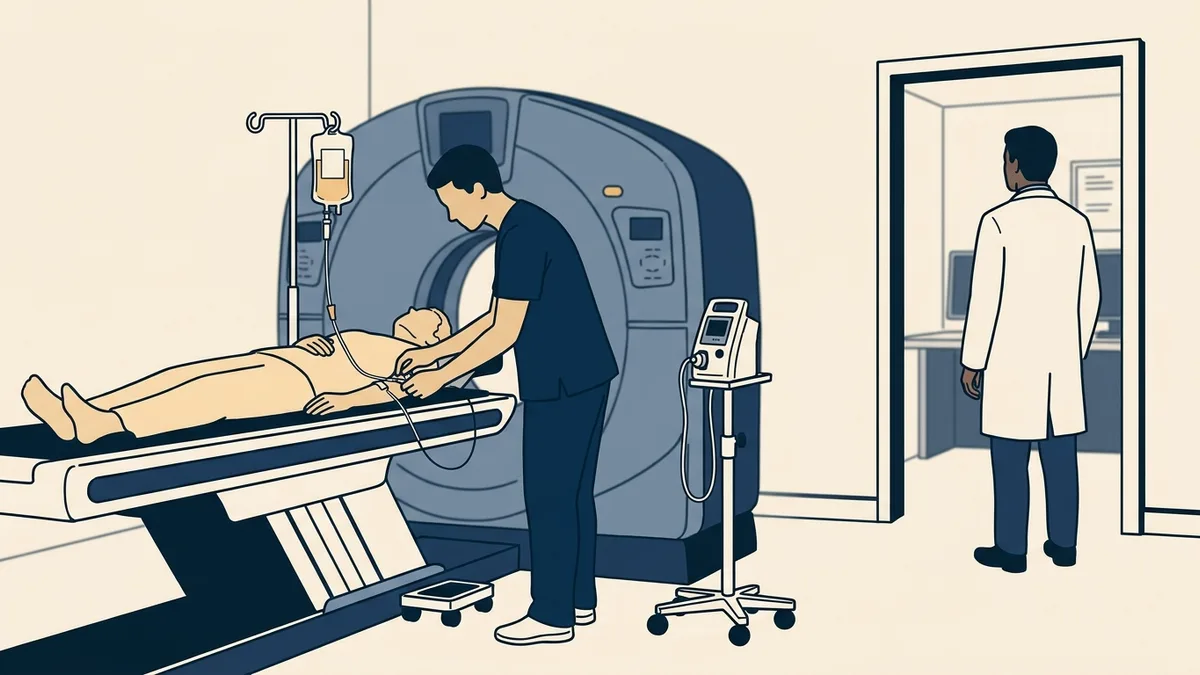
Medicare defines general supervision as overall physician direction without presence, direct supervision as the physician being in the office suite and immediately available, and personal supervision as being in the room. Virtual presence by real-time audio and video can meet direct supervision for services without a 010 or 090 global indicator.
Supervision is the word on the Medicare fee schedule that decides how many people you need on the floor. 42 CFR 410.32(b)(3) defines three levels, and each diagnostic service is assigned one. Getting the level wrong is not a paperwork detail, because an unsupervised test is a test Medicare may refuse to pay for.
Which three levels does Medicare define?
The regulation uses these definitions:
- General supervision. The procedure is under the physician's overall direction and control. The physician's presence is not required during the procedure.
- Direct supervision. The physician must be in the office suite and immediately available to furnish assistance and direction. For services without a 010 or 090 global indicator, virtual presence by real-time audio and video is allowed.
- Personal supervision. The physician is in the room during the procedure.
Which level applies to which test comes from the Medicare fee schedule's supervision indicator for each code, not from the center's preference. A physician who thinks a scan is routine does not lower its assigned level.
Which level applies to MRI, CT and contrast studies?
There is no single answer by modality. The level is tied to the individual code, so an MRI, a CT and a contrast-enhanced version of either can sit at different levels, and Medicare can change an indicator from one year to the next. Look up the current indicator for each code on your CPT list in the Medicare physician fee schedule rather than assuming from the scanner.
The contract between a center and its physician should say plainly who covers contrast studies and when. In an IDTF the supervising physician who is required to be available is the one named in the enrollment, which ties this directly to the limit of three sites per physician.
Who must personally supply direct or personal supervision?
Under 410.33(b), if a test needs direct or personal supervision, the supervising physician must personally supply that level, and the center must document physician coverage during all hours of operation. A physician may oversee concurrent direct-supervision procedures. A physician who is covering three sites cannot be physically present at all three when a direct-supervision study starts at each, which is why the rule and the coverage plan have to be designed together.
Can a technologist ever stand in for the physician?
For some tests, state law permits a Registered Radiologist Assistant or Registered Physician Assistant to perform personal-supervision tests under direct supervision (42 CFR 410.32(b)(4)). The permission depends on state law, so a center cannot rely on the federal text alone. Check the state before building a schedule around it.
How do the levels play out across a day?
Picture a center with an MRI and a CT and a supervising physician who covers it alongside two other sites. At eight in the morning the schedule is a run of studies at general supervision, and the physician is reachable by phone. At ten a study with a higher assigned level is booked. Now the clinical day depends on whether the physician can be in the suite, available by real-time audio and video if the code allows it, or in the room. The center's schedule has to be built around when those studies run, not the other way around.
That is why the supervision chart matters. If the center cannot show who supplies each level during each posted hour, it will be tempted to run the study and sort out coverage later, and later is when an inspector may be present.
Does virtual presence solve the coverage problem?
It helps in one situation. For direct supervision of services that do not carry a 010 or 090 global indicator, the regulation allows the physician's presence by real-time audio and video. It does not extend to personal supervision, which is the room, and it does not apply to the global-indicator services. The audio and video link should be reliable and documented, since the whole point is that the physician is immediately available. A phone that goes to voicemail is not virtual presence.
What should the center put in writing?
- A chart of every billed code with its assigned supervision level.
- A named person and a backup for each level and each hour.
- The technology used for virtual presence, and how it is tested.
- A policy for what happens when coverage is unavailable: the study waits.
Keep the chart next to the CPT list described in the enrollment attachment post, since both must agree.
How do you document it?
Keep a supervision chart: each code the center bills, its supervision level, the person or arrangement that supplies that level, and the hours covered. Inspectors do not need an essay; they need to see that the coverage during opening hours is real. A $149 Facility Readiness Review can build that chart against your CPT list before the Medicare application is filed.
Common questions
- What is the difference between direct and personal supervision?
- Direct supervision requires the physician in the office suite and immediately available. Personal supervision requires the physician in the room during the procedure.
- Can direct supervision be done by video?
- Yes, for services without a 010 or 090 global indicator, virtual presence through real-time audio and video can satisfy direct supervision under 42 CFR 410.32(b)(3).
- Who decides which supervision level a scan needs?
- The level is assigned to each service code under Medicare's rules, not chosen by the center. Look up the indicator for every code you bill.
- Does an IDTF supervising physician have to be present all day?
- Not for general supervision. For tests needing direct or personal supervision, the physician must supply that level, with documented coverage during all hours.
Need Help with Licensing or Enrollment?
We prepare the application for your radiologist, owner or authorized official to sign, then track renewals, inspections and changes.