
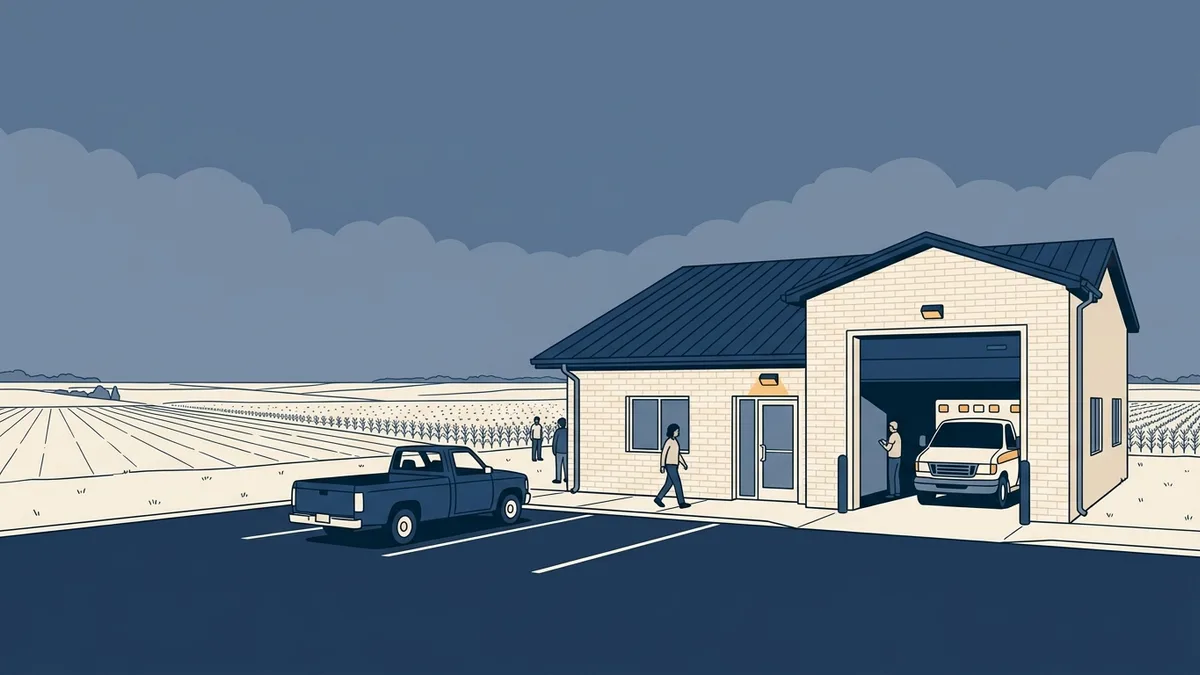
Critical access hospitals rely on 42 CFR 485.616(c) for telemedicine credentialing by proxy. It mirrors the general hospital rule: a written agreement must provide the distant site's privilege list, require a license issued or recognized by the state where the CAH sits, and return performance information to the distant site.
Small rural hospitals depend on teleradiology more than most. A critical access hospital (CAH) may have a technologist and a CT scanner but no radiologist on site. The Medicare rules for these hospitals have their own paragraph for telemedicine credentialing.
Where does the CAH rule live?
42 CFR 485.616(c). Paragraph (c)(1) sets duties for a distant-site hospital that provides telemedicine services, and (c)(2) sets conditions for the CAH's governing body to rely on that distant site's credentialing and privileging. The structure mirrors the one in 482.22(a)(3) and (a)(4), so a group that understands one understands the other.
Which conditions must a CAH agreement meet?
The agreement must ensure, among other conditions, that each practitioner has a license issued or recognized by the state in which the CAH is located. That is the same point as for a general hospital. The distant-site credentialing and privilege list must be provided and the CAH must send performance information back.
How do small hospitals differ in practice?
The federal text is the same shape, but the staff reading it may be one part-time medical staff coordinator with several other jobs. Plain documents help. A one-page privilege list for each radiologist, a short description of the group's credentialing process and a clear contact for performance information make a CAH's review faster than a long binder does.
Small hospitals also tend to change contacts often. Put the date of each agreement and the name of its administrator in the roster, so a renewal or a change to the agreement does not depend on someone's memory.
Why does it matter for a radiology group?
CAH contracts are often smaller in volume and bigger in number. A group that adds fifteen small hospitals in six states creates fifteen agreements and a set of state license needs. Packaging the same documents per hospital keeps each start from becoming a custom project.
The CFR text does not tell you how a state agency or accrediting body for your CAH reads these paragraphs. Ask each hospital for its own medical staff bylaws and any state-specific requirements.
Where does a group start?
Start from the roster: licenses by state, privilege list, credentialing process. Then prepare the agreement packet per hospital. White Glove Radiology prepares credentialing-by-proxy packets per hospital; the group and the hospital sign. See also the general proxy overview.
Common questions
- Which regulation covers critical access hospitals?
- 42 CFR 485.616(c), which sets duties for the distant site in (c)(1) and reliance conditions in (c)(2).
- Do CAH radiologists need a license in the CAH's state?
- Yes. The rule requires a license issued or recognized by the state in which the CAH is located.
- Is the CAH rule different from the general hospital rule?
- The structure is the same. Check each hospital's bylaws for local requirements.
Need Help with Licensing or Enrollment?
We prepare the application for your radiologist, owner or authorized official to sign, then track renewals, inspections and changes.