
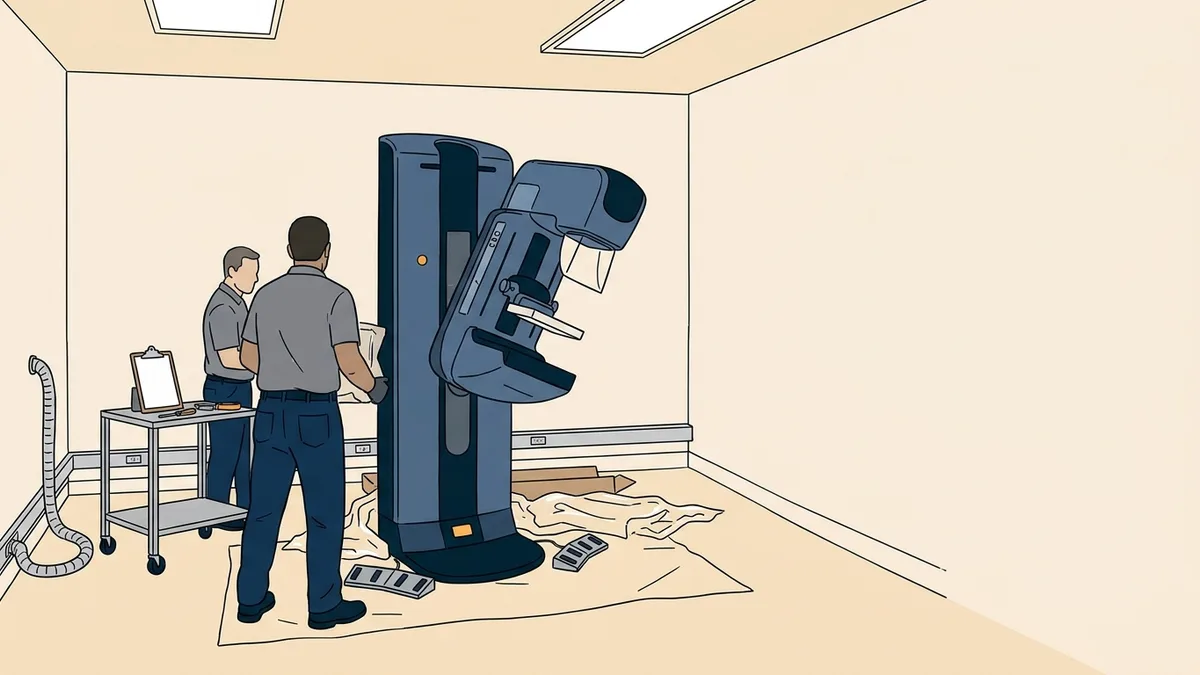
An IDTF that adds mammography needs an FDA certificate, accreditation by an FDA-approved body, credentialed interpreting physicians, technologists and a medical physicist. Under 21 CFR 900.11, a provisional certificate lasts up to six months, plus one 90-day extension, to gather the clinical images accreditation requires. The new service is also reported to Medicare.
An established imaging center has the building, the front desk and the referral relationships. Adding a mammography unit looks like one more room. In compliance terms it is a second program with its own certificate.
Does the Medicare enrollment change?
An IDTF that furnishes any mammography needs FDA certification, according to Noridian's guidance on IDTFs. Under 42 CFR 410.33(g)(16) the center must enroll for every test it furnishes, and the CMS-855B carries an attachment listing the CPT codes. So the new service is reported on the enrollment record, not just added to the schedule. Under 410.33(g)(2), changes other than ownership, location, supervising physician or adverse legal action are reported within 90 days; read the standard against your own facts and ask your Medicare contractor when in doubt.
Which comes first, the certificate or the unit?
Neither can come last. The FDA certificate requires accreditation by an approved body, and the accreditation requires clinical images. Under 21 CFR 900.11(b)(2) a new facility can apply for a provisional certificate that permits performing mammography to collect those images. It lasts up to six months, with one 90-day extension. Plan the equipment installation date backward from that clock. The full sequence is in how MQSA certification works.
Who has to be credentialed before opening?
Three groups, each with specific numbers in 21 CFR 900.12:
- Interpreting physicians need a state license, board certification or three months of formal training, 60 hours of Category I mammography education and 240 supervised exams read in the prior six months. See the full list.
- Technologists need a state license or national certification, 40 contact hours of mammography training and 25 supervised exams.
- A medical physicist must be available to survey the equipment.
Existing staff who image other modalities do not carry over automatically. Collect proof for each person before the date the unit goes live.
Why do the IDTF standards still matter?
The center's other duties do not pause. The supervising physician of the IDTF is still limited to general supervision of no more than three sites, and the center still needs its liability insurance, complaint log and posted standards. A mammography wing is a good moment to reread the 17 standards in 410.33(g) with a new room in mind.
A realistic sequence for an existing center
Established centers have an advantage and a trap. The advantage is a working front desk, a physician already supervising the IDTF and an enrollment on file. The trap is assuming the existing infrastructure covers the new service without a separate look. A workable order is below.
- Choose the accreditation body and ask for its application requirements. The FDA certificate depends on an FDA-approved body, and each body has its own forms and timelines.
- Confirm the room. A mammography unit has its own needs for space, shielding and patient privacy. Your medical physicist and your equipment vendor can tell you what the room must have. We do not design rooms.
- Name the people. Interpreting physicians, technologists and the medical physicist each have documented requirements; assign a quality control technologist, and write down the assignment.
- Update Medicare. Add the mammography CPT codes to the enrollment attachment and report the change in the time the standards set.
- Apply for the provisional certificate through the accreditation body when the unit is installed and ready, and begin collecting clinical images.
A common question: do we need a separate legal entity?
Not as a matter of the federal rules we reviewed. The facility is the unit that is certified, and it is the same site. Some owners choose a separate entity for liability reasons, but that is a legal and tax decision for their attorney, and a new entity brings a change of ownership or a new enrollment of its own. Do not create one casually in the middle of the project.
Patient volume and referrals
An IDTF accepts only physician-referred patients and may not directly solicit patients by phone, computer or in person (410.33(g)(7)). That applies to a new mammography service the same as to any other, so the launch plan should speak to referring physicians, not directly to the public through outreach that amounts to solicitation. Questions about marketing belong with your attorney; we do not help centers market to patients.
Which costs belong in the budget?
The unit and the physicist, plus the accreditor's fee and the FDA inspection fee, which the facility pays directly. White Glove Radiology does not collect or pass along any of those. Our Mammography (MQSA) Certification Readiness is $1,495 per site and covers preparing the credential files and the calendar; see pricing.
Common questions
- Can my IDTF add mammography?
- Yes, but the facility needs FDA certification for any mammography it furnishes, and the enrollment record and the CPT code attachment must reflect the new service.
- How long can we operate on a provisional certificate?
- Up to 6 months, with one 90-day extension if you qualify. It cannot be renewed after that.
- Do my current technologists qualify automatically?
- No. 21 CFR 900.12 sets mammography-specific training and supervised exam requirements, so collect proof for each person.
Need Help with Licensing or Enrollment?
We prepare the application for your radiologist, owner or authorized official to sign, then track renewals, inspections and changes.